 Asset Publisher
Polish forests
 fot. Paweł Fabijański
 fot. Paweł Fabijański
 fot. Paweł Fabijański
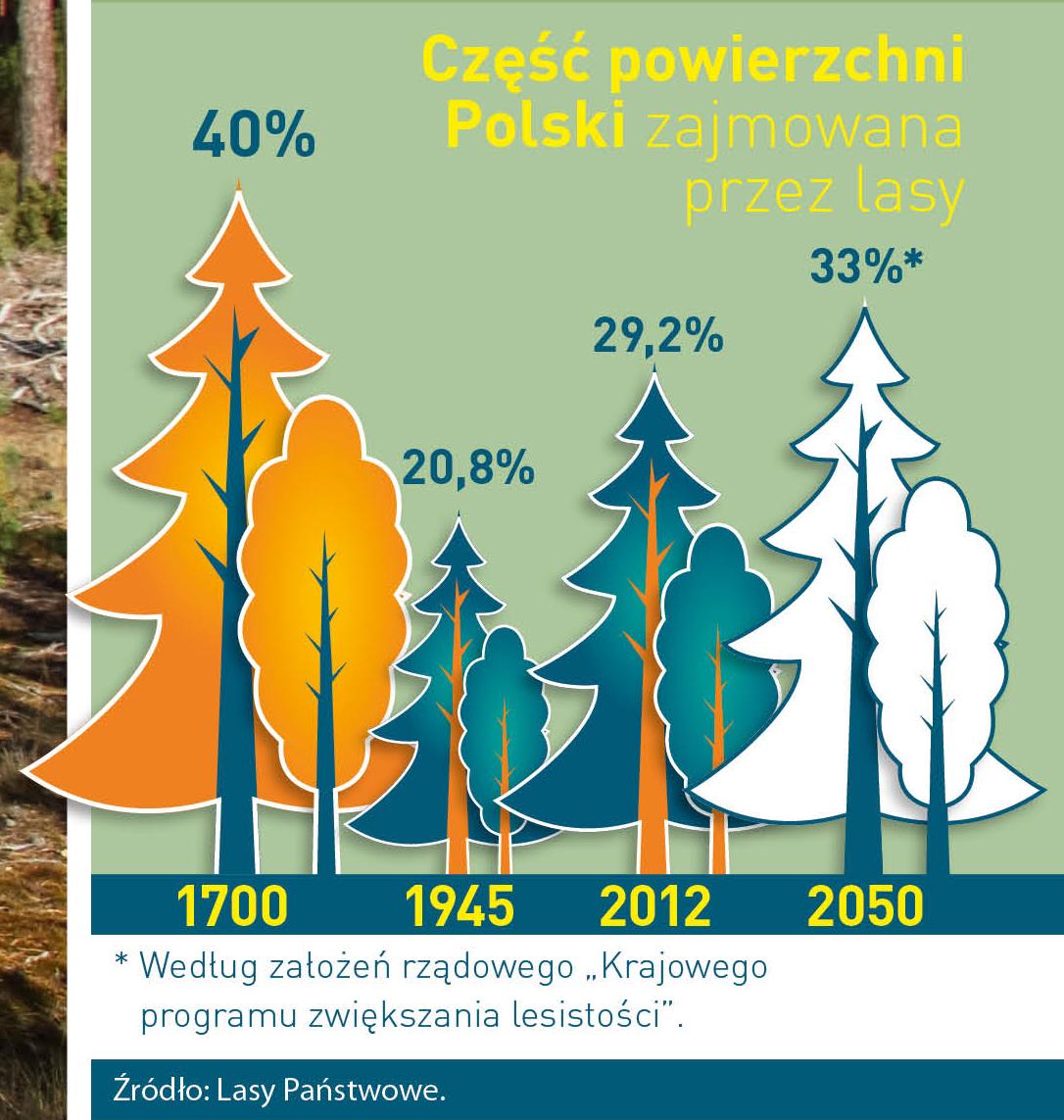
Poland is in the European lead, while concerning the area of all forests. They cover about 29,2 % of the country territory, and grow within the area of 9,1 million hectares. The overwhelming majority of the forests is state owned, of which almost 7,6 million hectares are managed by the State Forests National Forest Holding..
The number of Polish forest is still growing. The forestation rate of the country has increased from 21 % in 1945 to 29,2 % at the moment. Between 1995 and 2008, the forest area increased by 310 thousand ha. The basis for afforestation works is the "National Programme for Increasing the Forest Cover" (KPZL), assuming an increase of the forestation rate up to 30 % by 2020 and up to 33 % by 2050. Polish forests abound in flora, fauna and fungi. 65 % of the total number of animal species live there.
The forests grow in our country on poor soils, mainly because of the development of the agriculture in previous years. It influences the distribution of the types of the forest sites in Poland. Over 55 % of the forest areas is covered with coniferous forests. In other areas, there are forest sites, mainly the mixed ones. Their small part constitute alder and riparian forests – not more than 3 %.
In the years 1945 – 2011 the area of natural deciduous tree stands within the area of the State Forests National Forest Holding increased from 13 to 28,2 %.
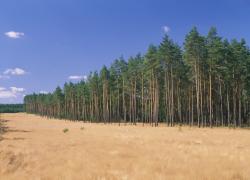
Within the lowlands and uplands the most often occurring tee species is pine. It covers 64,3 % of the forest area of the State Forests National Forest Holding and 57,7 % of private and commune forests. In the mountains the predominant species is European spruce ( in the west) and European spruce with beech (in the east). Domination of pine is the result of carrying on sustainable forest management in the past. Once, the monocultures (crops or cultivations of one species) were the answer to the great demand of industry for wood. Such forests appeared to be quite fragile to climatic factors. They also were often the prey of pests' expansion.
In Polish forests, the share of other tree species, especially deciduous trees have been systematically increasing. The foresters have stepped aside from monocultures – that is why, they try to fit specific species of the forest stand to the natural stand, that would be proper for the given area. Thanks to that, in the years 1945 – 2011, the area of the deciduous tree stands within the lands of the State Forests National Forest Holding increased from 13 to 28,2 %. There occur more and more frequently the following tree species: oaks, ashes, maples, sycamore maples, elms, but also birches, beeches, alders, poplars, hornbeams, aspens, tilias and willows.
Our forests are the most often represented by the forest stands aged 40 to 80 years. The average age of the forest equals 60 years. More and more trees are of big size at the age over 80 years. Since the end of the Second World War, the forests' area has increased up to almost 1,85 million hectares.
Raport o stanie lasów w Polsce 2012
Asset Publisher
Informacja o działalności Nadleśnictwa
Informacja o działalności Nadleśnictwa
Lasy Państwowe to organizacja zarządzająca większością zasobów leśnych w naszym kraju. Pod naszą opieką znajduje się ¼ powierzchni Polski. Nasze Nadleśnictwo jest jednym z 429 Nadleśnictw, które zarządzają lasami na poziomie lokalnym. Dba o przyrodę, udostępnia lasy dla rekreacji, ale również jest istotnym podmiotem gospodarczym, które dostarcza drewno, służące nam wszystkim.
W tym roku po raz pierwszy przygotowaliśmy raport z naszej działalności, skierowany do lokalnych samorządów, bowiem samorządy to nasz naturalny i blisko partner. Raport jest narzędziem dialogu ze stroną społeczną, która powinna dowiedzieć się jak najwięcej o naszej działalności, o jej efektach w minionym roku oraz o planach na rok następny. Debata i konsultacje w środowisku lokalnym mają szczególną wartość, ponieważ odbywają się w poczuciu odpowiedzialności i stanowią przejrzysty obraz naszej działalności.
Raporty z działalności Nadleśnictwa w roku 2024 oraz plany na 2025 r., zostały przesłane do Gmin znajdujących się na terenie zarządzanym przez Nadleśnictwo Ośno Lubuskie, aby każdy mógł zapoznać się z tym co robimy oraz jakie mamy plany na kolejny rok. Dostaliśmy zaproszenie do wzięcia udziału w posiedzeniu Rady Gminy w Górzycy, które odbyło się w dniu 29 maja 2025 r. W posiedzeniu Rady wziął udział Pan Robert Malina – inżynier nadzoru, który przedstawił Raport z działalności Nadleśnictwa Ośno Lubuskie w 2024 r. oraz plany na 2025 r.
Transmisję z posiedzenia Rady Gminy w Górzycy w dniu 29 maja 2025 r.,